

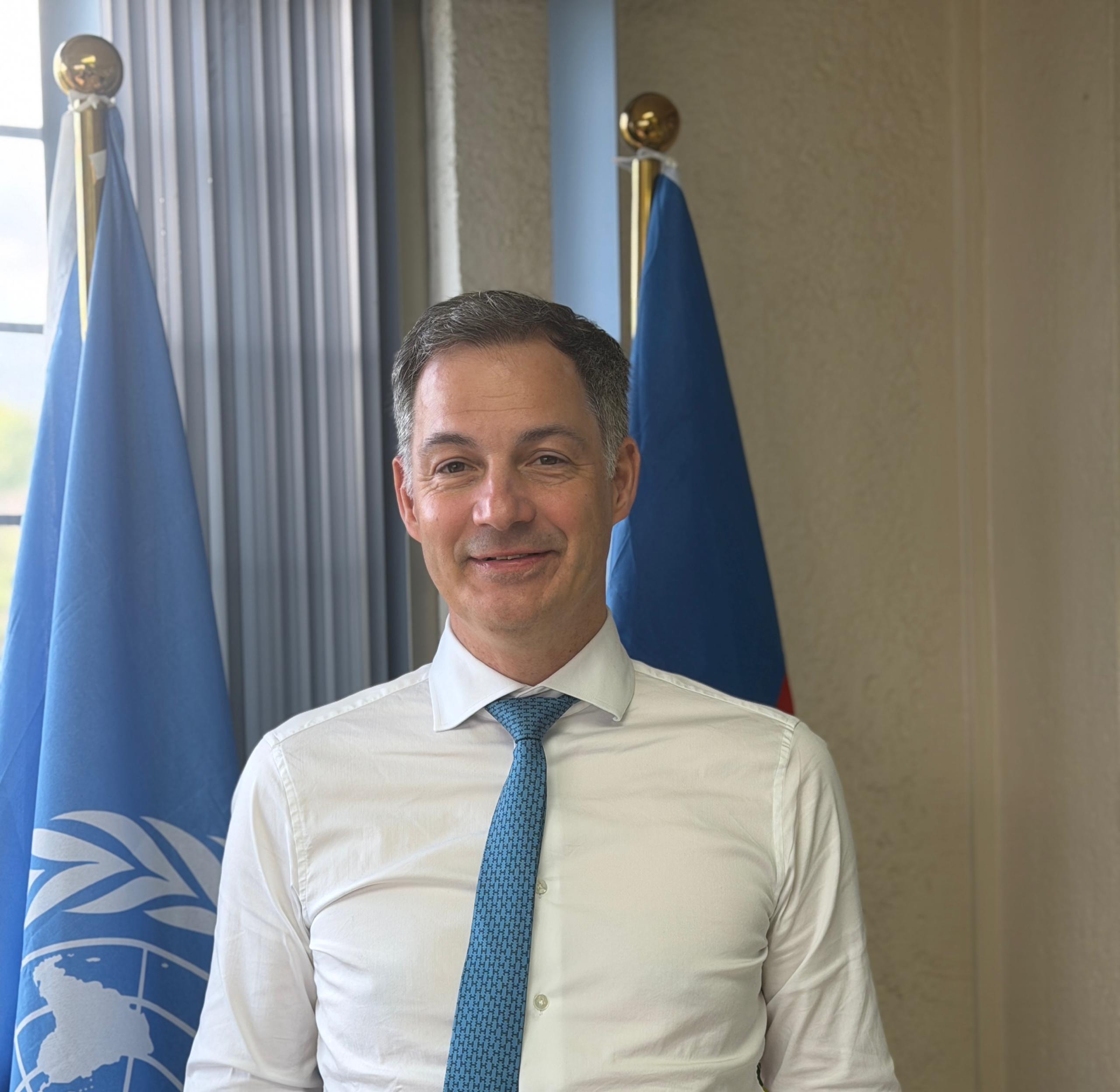
On an official visit to the country, Le Nouvelliste met on Tuesday, March 3, 2026, with the new administrator of the United Nations Development Programme (UNDP), Alexander De Croo.
Le Nouvelliste (LN): You took office as Administrator of the United Nations Development Programme (UNDP) just a few months ago. Why are you visiting Haiti so soon?
Alexander De Croo (ADC): Haiti is my second visit after the Gaza Strip and Palestine last week. It is also my first visit to the Latin America and Caribbean region. Why Haiti? Because at the beginning of my term, I want to visit the places that, for me, are… the places that demonstrate that development is multidimensional. And for me, Haiti is one of the examples where we see that a crisis situation stems from different dimensions, but where I also clearly see the potential path to recovery and emerging from these crises.
Multidimensional? Because we know very well that there is a situation linked to natural phenomena—earthquakes, cyclones—but also a human factor: insecurity, the gangs that play a significant role, the political instability we have witnessed, and there is no magic solution to this. Often, people think of development as simply doing this or that. No, there is no single solution, but there are important elements. One important element, and this is a strong conviction of ours, is that development is no longer a North-South discussion. It’s no longer a matter of the North telling the South what to do. In fact, this approach has often failed. All development that has taken place this way is a bit of a stop-and-go phenomenon. It progresses, then it collapses.
We are convinced that development and crisis recovery happen when there is local leadership, political leadership, deeply rooted in popular support, and committed to the cause. This leadership, yes, naturally uses some external funding, though less and less of it—we’ll talk about that later—but also relies on its own resources, on funds mobilized locally, where we truly provide support. We work together with the local population and local institutions.
And what we need to avoid is that, often in this context, there are people who say, “Things need to stabilize first, and then we can develop.” That’s a mistake. Because if we say things need to stabilize first, we’ll be waiting another 20 years.
No, we have to do it simultaneously. And it really means we have to cross the road together. When we see the security apparatus that’s being put in place, it’s the stick, but it’s also the carrot. So, if we want, for example, a population of young people to disengage from criminal activities, particularly in gangs, we have to give them an alternative. And that alternative is basic services: healthcare, schools, police, and other government services. And our experience shows that when these basic services are available, people return to them.
Violence isn’t something people like, it’s not something they find aspirational; it’s often seen as a solution to utter despair. So, this is a truly remarkable moment.
And I know that when we discuss this internationally, we can’t deny that there are people who look at it and say, “Yes, but we’ve had other situations like this, and it didn’t work.” We’re not in that position. Because the Haitian people don’t even have the option to hesitate. They live in this situation. They can’t say, “Yes, we’re going to leave.” No, they can’t leave. They’re trapped. I think we’re really taking this approach of, “Okay, let’s go.”
And our team here—we have 170 people. 150 are Haitians. They’re locals who bring us a great deal of knowledge and motivation. As I was saying earlier, we had a meeting with our whole group here. We don’t work here by chance. We work here because we truly believe in it. And I, well, I’ve been here for a day. So, I’m being a bit cautious. I don’t want to judge the situation based on being here for just one day. And we can read in all the reports that there are many indicators that are… indicators that are worrying. But spending a day here, talking with a political world that’s energetic and sees that there’s a possibility…
We had breakfast this morning with young people, and they’re entrepreneurs, influencers, a bit of everything. We could perhaps share the list of people, because I think it’s a really interesting list. So, there’s a real hunger, and it’s not a hunger in the stomach, it’s a hunger to take matters into our own hands, to demonstrate what we’re capable of. And we believe in it, and we want to be partners in this. We’re very aware that it won’t be an easy journey; it’s a journey with ups and downs, with mountains and valleys, but that’s often how it is in development.
LN: This is your second trip after Gaza, which speaks volumes in terms of qualifications and experience. Should we understand that Haiti occupies an important place on your agenda and among your priorities? Will this trip you’re currently undertaking in Haiti change UNDP’s policy in the country? Will it impact your strategy in Haiti?
ADC: What we’re seeing is that our local office here is experiencing very strong growth. We’ve doubled our team here in two years, and we’ve also doubled the number of activities we have. Everything we do here is funded locally. Funding from the local government shows that, as I was saying, this whole North-South perspective is completely changing, and that’s a good thing. The fact that we work with local funding demonstrates a willingness to invest, to allocate resources, and to avoid being in a difficult situation.
When people say, “You’re providing development aid,” no, not aid. I hate that word. We engage in cooperation, we make investments, we work together with local partners, but we’re not operating within an aid framework. We’re focused on creating mutually beneficial partnerships, and honestly, also on addressing issues that aren’t solely local.
When we work here to counter the effects of climate change, we can’t say that it’s a problem unique to Haiti. When we work here against precariousness, it’s a global problem; we live in such an interconnected world that it’s very, very widespread. And moreover, as an organization, we see that more and more, 20 years ago, development was primarily driven by public money, with the private sector playing a somewhat marginal role. Today, it’s not like that anymore; today, the private sector is at the heart of development. It’s about having
What’s important is that we see there are a great many organizations, as well as local political figures, that share the same objective. And there are differences of opinion, which is normal. Besides, you’ll have elections in August. I’m sure the candidates in these elections will come with different approaches, with different solutions. That’s how democracy works, and then the people will make a choice. What’s important is that the people will then hold politicians accountable. Accountable? That’s what you asked me, and that’s what we’ve done. Creating the conditions for this process to take place—yes, we will be a partner in that.
LN: Now, the Haitian crisis is multidimensional. We can also talk about the overlapping of humanitarian, political, and security crises. And concretely, on the ground, what is the role of the UNDP in resolving these different crises?
ADC: So, I’ll give you some examples, because we work in many different areas.
One, supporting the Haitian National Police. Naturally, we’re not a security organization, but what we’ve done with them is a procurement program—purchasing equipment, building infrastructure. How do we organize training programs? How do we organize a recruitment program? That’s exactly what we do.
We also work in agriculture. Well… what’s the problem? Too often today, agriculture is subsistence farming. The nostalgic view we have of agriculture is one of organized precarity, unfortunately. The way forward is to increase productivity and integrate technology, giving more control over pricing. So, that’s exactly what we do.
We are also, as I mentioned earlier, working closely with your Provisional Electoral Council on all the logistical aspects of the elections. We cannot afford for these logistics to malfunction. They must work now. How do we organize this? How do we ensure that these elections can take place in a stable and trusting environment? These are typically the areas in which we work, and where we very often create the basic conditions in which a society can stabilize, in which businesses and entrepreneurs can start, and jobs can be created. We create the framework for development. If a country recovers, it is thanks to its people. A framework.
LN: Now, since we are talking about security, in recent years this has been the main topic of conversation, the main concern. What we’ve noticed recently is a shift in the understanding of international partners regarding security solutions; we’re talking about a change in approach. The United States has changed its approach to security and its support for the Haitian National Police (PNH), as has Canada, and other international partners. At the UNDP level, is there a recalibration of your understanding of security? Of how to help? Because in the past, the UNDP was criticized, for example, for building police stations when that wasn’t the main problem, and what was needed was more equipment, more suitable equipment, etc.
ADC: And we did that, so I don’t mean to say that we listen when we’re criticized. One of the major programs we’ve worked on is equipment procurement, and what we’ve seen is that to carry out large-scale equipment procurement programs, you need the capacity and the knowledge to do it well, to execute it effectively.
So we were a partner in that. We handle the supervision and the procurement. We’re not an organization that would never train police officers, etc. I think some countries do that, by the way. What’s important for us, and we really want to emphasize this, is that if neighborhoods stabilize from a security standpoint, we must immediately stabilize them in other areas as well. We must immediately offer alternatives for people who are becoming disengaged. We must immediately provide schools for young people and try to create jobs. And that’s where we can help. I think we need to do a little more than what we often do; these are services that are currently being implemented. We subsidize these jobs because we want to say right away, “Here are the people who are working; they need to be compensated.” So for us, that’s what’s crucial. It’s not sequential; it’s not primarily about security.
Development is both at the same time. You can’t have development in an environment with such enormous insecurity. For us, it’s somewhat of a precondition, but a precondition that must be met in stages.
We really need to proceed in parallel. So, have we changed our approach? I’m not sure. We see that the elements are in place, the recruitment is underway, the GSF will be there, and we are ready to work in parallel with the security forces; we’re not doing it ourselves.
LN: Is the UNDP being approached for a possible disarmament and reintegration program?
ADC: That’s what we call DDR, which stands for disarmament, demobilization, and reintegration. We’re mainly focused on the R, on reintegration.
We do that. We don’t have the capacity to do disarmament itself. Demobilization, well, it’s a bit of a hybrid. So, what we call DDR programs, yes, we do them, but primarily focusing on the reintegration aspect. People will disarm and demobilize if they see that reintegration is available. Unfortunately, we don’t offer reintegration; very often it’s a choice people don’t make.
LN: Regarding the elections, what concrete support would you provide for organizing the elections in Haiti?
ADC: Concretely, it’s all the logistical and material aspects for voter registration, to ensure that everyone who should be eligible to vote actually gets to vote.
All the logistical elements, maintaining an ambitious electoral calendar. We’re going to be, well, we’re at the beginning of March, and the elections are in August; we can’t afford to delay.
As for the political side, well, that’s not up to us. That’s not our decision, but you know, we have a lot of experience in that area. In the two previous years, between 24 and 25 combined, UNDP organized elections for 817 million voters worldwide.
We have done a tremendous amount of work in this area; we know it quite well, and these elections will also represent the largest investment for us in terms of resources—the most important election globally. It’s extremely important for us. We have a great deal of experience to share. We are working very closely with the Provisional Electoral Commission. And our support is truly substantial in terms of logistics.
LN: Speaking of logistics, were you asked to help modernize the voting and tabulation methods? We often hear about electronic voting, etc.
ADC: We had a discussion yesterday with the president of the Provisional Electoral Council (CEP). It’s a paper ballot, it’s an electronic registration.
I think for us, it’s the best option. Regarding the registration, we need to be sure that people don’t vote twice. And we do that electronically, and the information circulates. But the vote itself is a paper ballot, because a paper record is still important. We need to be sure that there’s a way to control everything. Also, to give the population… People who were 17 years old 10 years ago have never voted. This is the first time they’ll vote. So, it’s a process, how to say, a certain political and civic culture, where people know, well, this is how politics works, and that’s the role I can play in it. It’s also an educational exercise, and I said that in a very positive way. It takes time, so what’s crucial is that the elections go smoothly, are organized as simply as possible, and, on the other hand, as securely as possible.
LN: Does the UNDP have a strategy for youth integration? Because earlier, you said that yes, we need to solve the security problem, but we also need to solve the development problem to both enable and discourage people from joining gangs. Do you have a strategy for this segment of the population, which is the majority in Haiti?
ADC: Yes, so clearly what I took away from the discussion we had this morning—there were about ten of them—is that there’s a real need for this young population to say, “We’re proud of ourselves, we have abilities, we don’t want to be in this situation of dependency, going from one misfortune to another.” And there’s a real need to say, we want to show what we’re capable of. There’s a certain pride, a certain desire to say, we’re going to take matters into our own hands, even if it means proving ourselves. We’re already doing that in our own way. We have this program, “Ayiti Kapab.” Yes, but it’s important to convey this message.
Then, we have many young entrepreneurs who say, “If you’re working on stabilizing a security plan, working on improving the legal framework, e-government services,” well, all of that helps us.
Is it primarily young people who benefit most from everything that stabilizes the country and creates an environment where economic recovery can take place?
LN: The international community often says it wants to help Haiti, but we get the impression that this desire isn’t translating into concrete actions. Do you have an overview of the situation, do you have an idea of the current state of international community mobilization in Haiti?
ADC: We’re still, I think… globally, we’re 14th (in terms of volume)… and 4th in Latin America and the Caribbean. For a country of 11-12 million inhabitants, being 14th globally shows its importance.
It shows that it really is, and this is in absolute numbers, it shows that it’s an important country and that we’ve managed to mobilize a lot of resources. Some of these are local resources, but a large part are international resources from donors. The biggest donors are Canada, Japan, Switzerland, and Europe. And the two banks, the World Bank and the Inter-American Development Bank. We’re partners in this, trying to mobilize the funds.
So, our long-term ambition is that we won’t have to do anything more. Our ambition is not to perpetuate our work here. We want the country to recover as quickly as possible. So, I think we remain very active here. And as I was saying, we have doubled our activity here, which I think is a positive point, but with a real desire to ensure that it is mobilized as much as possible at the local level.
 Total views : 6094
 Who's Online : 0
 Your IP Address : 216.73.216.250
